
Custom Sterling Silver Jewelry for Jewelry Brands
A brand buying its first silver collection is really buying three things: a material decision, a quantity decision and a paperwork decision. The published numbers make the first two concrete — 925 sterling silver at 50 pcs per design, brass at 100 and stainless steel at 100+, with MOQ tiers that differ by a factor of two — and the third is the ISO 9001:2015, BSCI and REACH file that your retail partners will eventually ask to see.

Key takeaways
- Silver tooling starts at 50 pcs per design, half the 100 pcs brass minimum, and the gap decides how many designs a first collection can carry.
- Send sketches, reference photos or a tech pack; CAD comes back inside 48 hours for dimensional sign-off.
- OEM means you bring the drawing and the factory builds it; ODM means you bring a mood board and co-develop the line.
- Hallmarks, laser engraving and branded packaging are separate line items inside the six customisation options.
What a brand actually has to decide before the first quote
Three fields move the price more than anything else: the base metal, the finish family and the packing format. Base metal is the hardest to reverse later because it sets the mould, the minimum and the plating chemistry. Finish can be re-specified on a repeat run. Packing is the least costly to change and the first thing a retail buyer asks about.
The MOQ by base material is 100 pcs in artisan brass, 50 pcs in 925 silver and 100+ pieces in stainless, counted per design quoted per design. Those three numbers are the skeleton of your launch plan. A silver range of four designs starts at 200 pieces; the same four designs in brass start at 400.
OEM or ODM: two doors into the same workshop
OEM is stated as "you design, we produce" — you arrive with CAD files or a drawn concept, the factory produces to your specification, and the IP stays yours. ODM is "you inspire, we create" — a concept-and-finished-product service where the collection is developed with you and stays exclusive to your brand.
Most brands use both: OEM for a hero design that already exists in a founder's sketchbook, ODM for the rest of the line that has to be filled out fast. Deciding which route a given design takes is a commercial question about how much of the development conversation you want to own, not a quality difference.
What the design team needs from you
Hand drawings, reference photographs, an existing piece with change notes, or a full tech pack are all accepted inputs. Nothing has to be drawn to scale, and nothing has to be a vector file. The CAD stage exists precisely to convert loose intent into a dimensioned drawing, and it lands within 48 hours for approval.
Send the constraint list in the same message as the designs: target retail price band, metal, finish, order quantity per design, and whether the piece will be photographed on a model. Those five items decide whether a detail survives manufacturing, and each one costs nothing to state up front.
Sampling, then production: what the calendar looks like
After CAD approval comes physical sampling at 25–30 days, which covers 3D wax printing, mould casting, stone setting, polishing and electroplating. Mass production after the approved sample is typically 3–4 weeks, and final inspection covers 100% of the pieces before packed cartons go out.
For a first silver collection, that is a realistic runway of about seven to nine weeks from an approved drawing to a shipped order, excluding your own approval time. A workshop that will not put those two windows in writing at enquiry stage is telling you something about how it runs the bench.
Hallmarks, engraving and packaging as part of the brand
Silver orders carry the S925 hallmark, applied by high-precision laser engraving, and the same laser can place a brand mark on a clasp or an inner band. Hallmarks state the metal; the brand mark states the company. Both are engraved after the surface stage, so they belong in the CAD drawing if placement matters.
Packaging is published as a defined list: velvet or microfiber pouches, bar-coded labelling, metal logo tags, foil-stamped boxes and backing cards. For a brand selling into a shop or a stall, the backing card and the barcode are not decoration, they are the difference between a stock item and a gift.
Four silver-specific details come from the manufacturer's own line page: each piece is stamped S925, the metal is nickel-free and allergy-free, plating is eco-friendly electroplating over a 925 base, and the quality block names ISO 9001:2015, BSCI and REACH. Sample testing is offered before production, so a brand approves the metal and the finish on a real piece rather than on a rendering.
Paperwork to request once, at the start
The published compliance file is short and specific: ISO 9001:2015 certification, a BSCI social audit and a REACH statement covering lead, cadmium and nickel. Plated work is stated as compliant with REACH and CA Prop 65.
Request the documents with the first sample rather than with the first production order. A retail partner asking about nickel release is a normal event, and it is much easier to answer with the file already in your drive.
Where each plating option goes
| Plating | Published on | Typical fit |
|---|---|---|
| Rhodium | Silver and brass | Keeps the piece reading as white metal |
| 14K gold | Silver and brass, multi-layer | Warm tone at the entry end |
| 18K gold | Silver and brass, multi-layer | The middle tone most gold collections use |
| 24K gold | Silver and brass, multi-layer | The deepest yellow, for statement pieces |
| PVD vacuum plating | Stainless steel | Daily-wear pieces with a harder finish |
Worked example: sizing a first collection to the minimums
Say the plan is a debut range of four designs — two rings, a bracelet and a pendant. In artisan brass with recycled content, 316L stainless steel and 925 silver, 4 × 100+ = 400+ pcs. The silver route buys the smallest opening order, which is why it is usually the right first material even before the retail maths.
Now split that 200-piece silver opening across sizes. Two ring designs across five sizes means 10 size variants before the bracelet and pendant are counted. Those 200 pieces are a saleable opening order only if the sizes are chosen from real sales data, not an even spread — my own conclusion, from the published per-design minimum.
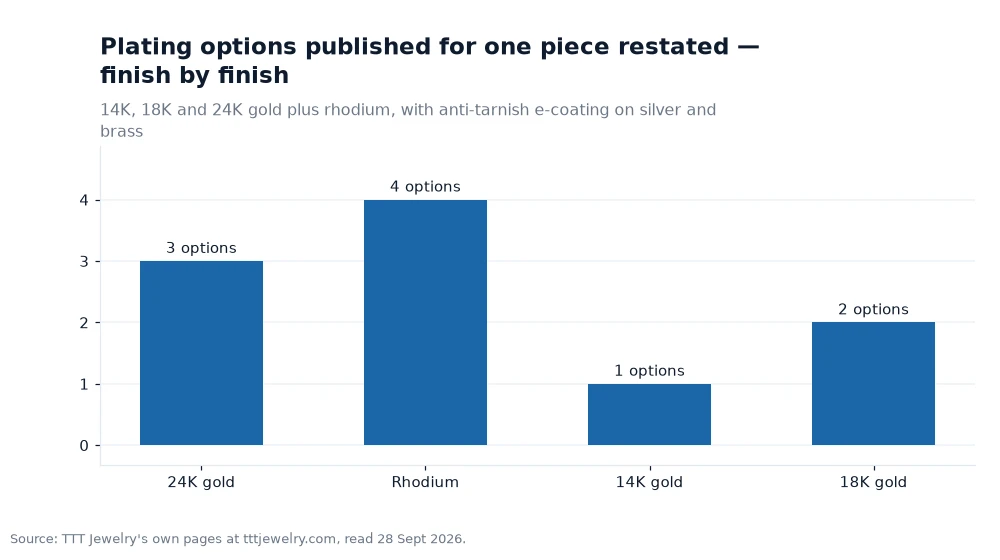
The chart below restates the plating options as a menu rather than a paragraph. It counts finishes, not production capacity, because capacity figures are not published.
Questions worth asking before you commit tooling
The brand-side test of a wholesale 925 silver jewelry factory is not the price list, it is the answers to three ownership questions. Ask who holds the mould after the run, how a repeat order is scheduled, and what the sample approval process looks like if a dimension is wrong. The published answers are clear on ownership: designs under NDA stay exclusive to the brand, and moulds, CAD files and collections are not resold or published. Agreements are 100% NDA covered.
Then ask what happens between approval and delivery. A 1-on-1 dedicated project manager and a 24-hour response window are the two support commitments published, and they matter most in the two weeks after a sample ships, when feedback loops decide whether a launch date holds.
Frequently asked questions
How many designs can a first silver order include?
As many as you can fund at 50 pcs per design in 925 sterling silver; each additional design adds another 50 pieces to the opening order rather than re-using the previous design's allocation.
Do I need my own CAD files to place an order?
No. Sketches, reference photos, a physical sample with change notes or a tech pack are all accepted, and the CAD drawing comes back within 48 hours for you to approve the dimensions.
Who owns the design and the mould after production?
The brand does. Designs stay exclusive to your brand under 100% NDA cover, and moulds, CAD files and collections are not resold or published by the manufacturer.
Starting the conversation
The most useful first message is short: designs, metal, finish, quantity per design and a target date. Everything else — hallmarks, packaging, plating colour — can be settled later without moving the price of the piece. What cannot be settled later is the metal, because it fixes the minimum.
If your opening range is more price-sensitive than precious, read the brass and plating route before committing tooling, and if the pieces have to survive showers and gyms, compare the steel and PVD option on the same brief.
Everything factual here — the ISO 9001:2015, BSCI and REACH statements, then the eco-friendly electroplating plus the S925 purity stamp — comes from the manufacturer's published pages via tttjewelry.com, checked 28 Sept 2026. The side-by-side reading is my own construction, and nothing else here[1].