
Working Backwards From a BTC Target to a Hashrate You Can Buy
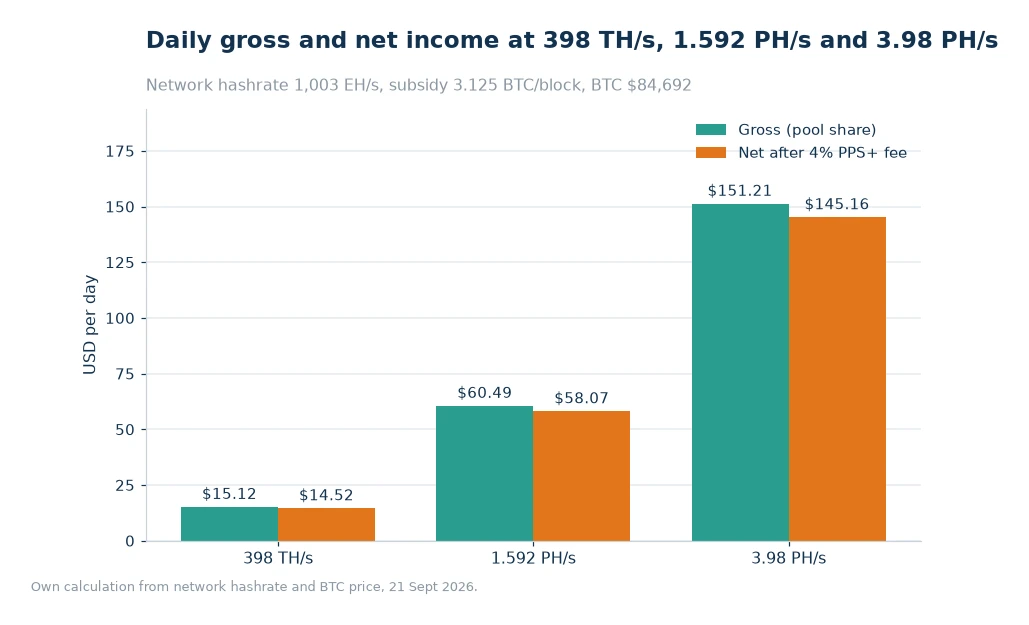
Most mining plans start with hardware and end with a number nobody chose. It is more useful to start with the number. If the goal is 0.001 BTC a day, the arithmetic says 2,229 TH/s before fees, which at $84,692 per coin is $84.69 of daily output. A single 398 TH/s machine produces 0.00017855 BTC, or $14.52 after the listed 4%, so the target is a fleet question rather than a shopping question.

Key takeaways
- One 398 TH/s machine yields 0.00017855 BTC a day, or $14.52 after the listed 4%.
- Reaching 0.001 BTC a day gross needs 2,229 TH/s; net of the listed 4%, about 2,322 TH/s.
- Every target converts to a dollar figure at $84,692 per BTC, which is what the hardware must beat.
- The reverse calculation ignores power, so subtract the meter before deciding the fleet size.
The formula, rearranged
Forward, the calculation is hashrate divided by network hashrate, multiplied by 450 BTC a day and by one minus the listed rate. Backwards, it is the target in BTC divided by 450, multiplied by network hashrate, then divided by one minus the rate. Same identity, different unknown. The only care needed is with units: the network is quoted in EH/s, the target in BTC, and the answer in terahash.
The rearrangement is worth doing once by hand, because it exposes how large the network is relative to any single purchase. At 1,003 EH/s, one terahash is a billionth of a millionth of the total, and the daily output per terahash is a fraction with six leading zeros. That is not a reason to avoid the calculation; it is the reason to keep it in a spreadsheet rather than in your head.
Three targets, three hashrates
The table converts daily BTC targets into the hashrate required to reach them, using the 21 September 2026 network figure. The dollar column is the gross value of the target at $84,692, which is also the revenue the fleet has to generate before power and fees.
| Target per day | Hashrate required | Gross value |
|---|---|---|
| 0.0005 BTC | 1,114 TH/s | $42.35 |
| 0.001 BTC | 2,229 TH/s | $84.69 |
| 0.002 BTC | 4,458 TH/s | $169.38 |
Doubling the target doubles the hashrate, which sounds obvious and is worth seeing written down: there is no economy of scale in the mining arithmetic itself. Scale appears only in the costs, where one transformer, one room and one invoice serve many machines. That is why a fleet can be viable when a single unit is not, and why the reverse calculation should always be followed by a cost calculation.
From a hashrate to a machine you can order
Hashrate on a specification sheet is nominal, and the number that matters is the one the machine actually delivers on the pool. A 398 TH/s unit might run at 392 TH/s in a warm room, so divide the target by the realistic figure rather than the marketing one. Then round up, because a fleet that exactly meets a target has no headroom for a failed board or a difficulty adjustment.
Before ordering, check the model against the Miner Profitability Ranking, which reads current price and difficulty instead of the numbers printed on the box. It is a second opinion on whether the machine you have chosen still earns its place, and it costs nothing to look.
There is also the question of whether the target should be expressed gross or net. If the plan is to hold 0.001 BTC a day, the listed 4% has to be grossed up: divide by 0.96 to get 2,322 TH/s. If the plan is to spend $84 a day, the gross figure is the one to use. Mixing the two is a common source of a plan that is 4% short from the first day.
Worked example
Two directions, one set of numbers.
- Daily network output: 3.125 BTC × 144 blocks = 450 BTC.
- Output per TH/s: 450 ÷ 1,003,107,267 = 0.000000448606 BTC.
- Forward at 398 TH/s: 398 × 0.000000448606 = 0.00017855 BTC.
- In dollars: 0.00017855 × 84,692 = $15.12.
- After the listed 4% on the block-reward component: 15.12 × 0.96 = $14.52.
- Backward for 0.001 BTC: 0.001 ÷ 0.000000448606 = 2,229 TH/s.
- Net of the listed 4%: 2,229 ÷ 0.96 = 2,322 TH/s.
Check the two directions against each other. 2,322 TH/s is 5.83 times 398 TH/s, and 5.83 × $14.52 is $84.68, which is what 0.001 BTC is worth at $84,692. When the forward and backward answers agree, the spreadsheet is probably right, and when they do not, a unit has slipped somewhere.
What the target ignores
Three things sit outside the reverse calculation. Power is the first: a fleet large enough for 0.001 BTC a day draws something like 45 kW at 20 J/TH, which is over 1,000 kWh a day and a four-figure monthly bill at most tariffs. Cooling, space and the electrical upgrade to support that load are the second. The third is time, because difficulty rises and a fleet sized today produces less in six months.
Those omissions are not a reason to skip the calculation, they are the reason to finish it. Take the hashrate the target implies, then price the power, the room and the connection. If the resulting margin is thin, the target is not achievable at this price and this tariff, and the honest move is to change one of the three rather than to buy the hardware and hope.
Choosing the target in the first place
A target should come from a use, not from a round number. Replacing an income, covering a power bill, or accumulating a fixed amount of BTC by a date are all legitimate and each implies a different plan. A target with no use behind it tends to drift upward until the fleet is larger than the margin can support.
Use the ViaBTC Mining Calculator to test a target against any hashrate without rebuilding the sheet, and keep your own cost columns beside it. The tool answers the mining half of the question quickly, which leaves the slower half, where the equipment sits and what the power costs, to the person signing the lease. That division of labor is worth preserving, because no online estimate knows your tariff.
Write the target, the date and the price assumption next to each other. Then run the reverse calculation at the current difficulty and again at 10% higher, which is roughly a few months of normal growth. If the plan survives the second version, it is robust enough to act on. If it only works at today's difficulty, it is a bet on difficulty standing still, which is not a thing that happens.
Frequently asked questions
How much hashrate do I need for 0.001 BTC a day?
About 2,229 TH/s at network hashrate 1,003 EH/s before fees, or roughly 2,322 TH/s if the 0.001 BTC is meant to arrive after the listed 4%.
How many 398 TH/s machines is that?
Six would produce 0.0010713 BTC a day gross and 0.0010284 BTC after the listed 4%, so six units clear the target with a small margin for downtime.
Does the reverse calculation include power costs?
No. It converts a BTC target into hashrate only, so subtract the meter separately: one 398 TH/s machine earns $14.52 net and can spend most of that on electricity at a modest tariff.
Pick the target, then price the fleet
Two numbers, in this order: the daily BTC you actually want, and the hashrate that produces it. Everything else, including which machines and where they sit, is a cost problem that follows. Doing it in the other order is how people end up with a fleet and no idea what it was for.
The ViaBTC App is a reasonable place to watch the result once the fleet is running, since it shows hashrate and credits without a laptop. Before that, the Profit Calculator gives the forward figure to check against the target, and a simple sheet handles the costs the pool cannot see.
Sources: the ViaBTC calculator and app pages for output estimation and monitoring[1]. Chain data read 21 Sept 2026: network hashrate 1,003 EH/s, difficulty 132.76 T, 3.125 BTC per block, 144 blocks a day, BTC $84,692. Published 22 Oct 2026; power examples are illustrative.